. Extreme events and river biodiversity under climate change
2026 – Nature Reviews Biodiversity
Jonathan D. Tonkin, Tadeu Siqueira, Julian Merder, Thibault Datry, N. LeRoy Poff, Julia Talbot-Jones, Julian D. Olden
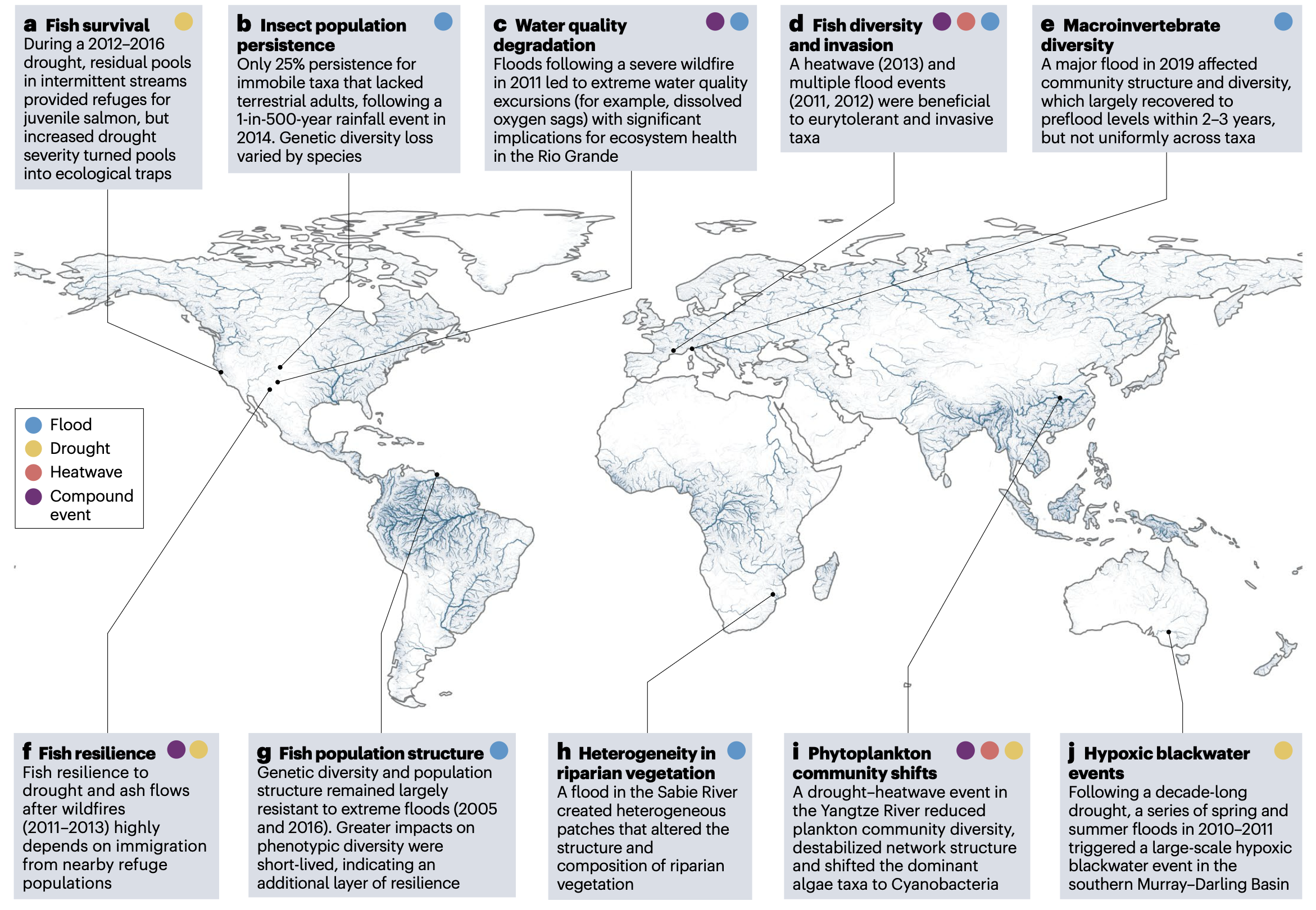
Extreme climatic events (ECEs) including floods, droughts and heatwaves are increasing in severity and frequency, fundamentally reshaping riverine ecosystems. In this Review, we synthesize global evidence of the impacts of ECEs on riverine biodiversity, revealing widespread and often compounding threats. ECEs affect biodiversity in diverse ways across scales; they can erode genetic diversity, alter community composition, reduce ecosystem function and disrupt population and community synchrony across the wider river meta-network. ECEs can also amplify the impact of, and be amplified by, other global stressors, and ECEs that occur in tandem or sequentially (compound events) have potentially strong but poorly understood biodiversity impacts. Several promising statistical and mechanistic modelling frameworks now enable prediction of the impacts of ECEs under non-stationary conditions. To adequately prepare for increasing and compounding ECEs, management strategies must shift from local, reactive interventions to catchment-scale, resilience-focused approaches. Top future research priorities include high-frequency and coordinated long-term monitoring, understanding legacies and biophysical feedbacks from extremes and deconstructing the impacts of compounding events. Our synthesis provides a roadmap for advancing science and practice to confront the ecological challenges posed by an increasingly extreme future.